

“I have a hearing disability.”
It was one of the first things I told the woman at the emergency room registration desk. I explained that there was a good chance I wouldn’t hear my name if someone called it across a crowded waiting room, so I asked her to wave, walk over, or make sure I knew when it was my turn. She nodded.
A few minutes later, someone called my name.
I didn’t hear it.
Less than twenty-four hours earlier, I had walked out of a job interview feeling hopeful about the future. Now I was sitting alone in an emergency room in excruciating pain while my husband stayed home with our two babies. Every half hour, we exchanged messages. He checked on me. I checked on them. I kept telling him to stay home with the kids, even as part of me desperately wanted him there with me.
Thankfully, I had come prepared. Years ago, my mom taught me a lesson I never wanted to learn. That lesson was that no one was coming to carry the burden of my disability for me, I had to carry it myself. Whenever I walk into an unfamiliar situation, some part of me is already planning for everything that could go wrong. My go bag has backup chargers for my hearing technology, my caption glasses, and the tools I might need if communication breaks down.
That preparation mattered almost immediately. During intake, a nurse asked me a question while facing away from me, even after I had explained that I have a hearing disability, lip read, and need people to face me when they speak. I completely missed what he said, but my caption glasses caught it. He was asking about allergies. I have a life-threatening one. For a moment, I felt relieved. The technology had done exactly what it was supposed to do. Years of preparing had paid off, and I assumed the hardest part was over.
I was wrong.
Even after telling the front desk I was deaf, I spent the next eleven hours scanning faces, doorways, doctors, nurses, and every movement around me. I sat near the entrance so I had the best possible chance of catching someone calling my name. I couldn’t fully rest because some part of my brain knew it had to stay on guard. I was terrified that closing my eyes for a few minutes could mean missing my name and spending one second longer there than I had to.
I thought about my babies at home without me and my husband taking care of them while worrying about me. I thought about how badly I wanted to close my eyes and just be sick for a minute. I wanted the luxury of being a patient whose only responsibility was getting through the pain. Instead, part of my attention always had to remain fixed on the room around me.
The emergency room had turned my hearing loss into a second emergency.
I missed my name the first time it was called, and that first missed call wasn’t the last. At one point, I walked back up to the nurse’s station and asked, “Is it in my chart that I’m deaf?” They assured me it was.
It didn’t matter.
Before I ever saw a doctor, I was called verbally five separate times. For intake, for vitals, for an ultrasound, for bloodwork, and finally for the exam room. Every single time, someone stood in a doorway and called my name. Every single time, if I caught it at all, I had to explain that I was deaf. Every single time, I had to remind them how to get my attention. Every single time, the hospital failed to do the one thing I had asked for from the very beginning, to simply walk over and wave.
That was the bar… A wave.
I don’t know whether anyone saw the note in my chart, read it, or understood what to do with it. I only know what happened to me as the patient. The responsibility for making the system work kept falling back on me. I had come to the emergency room because I was in pain, and somehow I was also responsible for making the emergency room accessible to me.
By the end of the night, as my husband and I drove back home, I joked that next time I had to go to the emergency room I would bring a dry erase board and hang it around my neck like someone waiting at airport arrivals:
PAULINO. I AM DEAF. PLEASE COME GET ME.
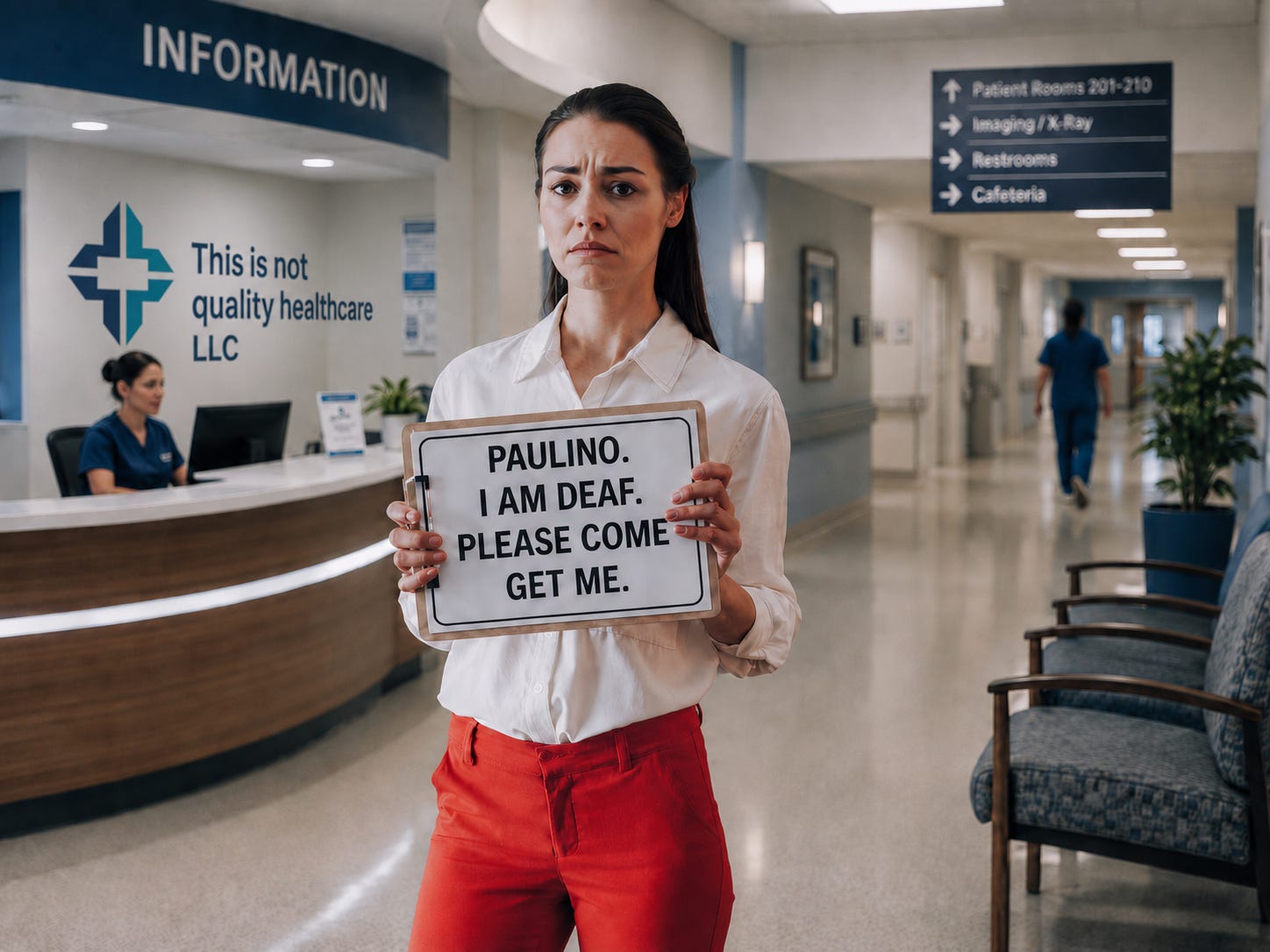
The absurdity made me laugh. Then it made me cry. Then it made me angry.
On the drive home, I thought about filing a complaint. I’ve spent years writing those emails, filling out surveys, explaining what went wrong, and telling organizations how they could do better. I’ve heard every version of “We’ll use this as a learning opportunity.” This time, something in me had changed.
My communication disability was documented. I repeatedly communicated what I needed. And for eleven hours, I still had to wonder whether I would miss the medical care I was sitting there waiting to receive. I’ve decided that what happened deserves accountability beyond another complaint, and I’m taking the steps I believe are necessary to pursue that.
But accountability for yesterday can only do so much. I keep thinking about tomorrow.
The most frustrating part of this entire experience is how solvable it was. The research exists. The training exists. The consultants exist. The technology exists. The standards exist. Most importantly, people with hearing disabilities have been telling organizations what we need for years.
Visual patient-calling systems exist. Text messaging exists. Captioning exists. And a nurse walking ten feet and waving definitely exists. We have tools. We have expertise. We have people with lived experience ready to help. What we need is the urgency to put those pieces together before someone is sitting alone, scared, and in pain.
And that realization has left me sitting with a much harder question…if this was my experience, what happens to someone with less?
I hear with a cochlear implant. I communicate well through spoken language in a way that is easily understood. I understand accessibility and know how to advocate for myself. That night I had caption glasses on my face, backup technology in my bag, a charged phone in my hand, health insurance, and a husband checking on me every thirty minutes.
And I still struggled.
I keep thinking about the person who recently lost their hearing and has no idea what accommodations they can ask for. The older adult whose family thinks they’re “just not listening.” The Deaf patient whose primary language is ASL. The person who lip reads and encounters someone speaking behind a mask. The parent terrified they won’t hear their baby cry. The traveler who misses the gate change because the announcement only existed in sound. I keep thinking about the person who has asked for help so many times that eventually, they simply stop asking.
That question extends far beyond one emergency room. A missed name can delay medical care. A missed alarm can become an emergency. A missed announcement can leave someone stranded. A warning delivered only through sound can become a safety issue. So I’ve been thinking about what happens when we stop treating each of those moments as isolated accessibility problems and start bringing people together to solve them.
My mother has always said the problem isn’t just the problem, the problem is also the solution. On March 3, 2027, World Hearing Day, I’m hosting The Hearing Access & Inclusion Unconference & Hackathon.
The idea is simple. Start with real problems experienced by real people. Bring Deaf and hard-of-hearing people into the room alongside engineers, designers, students, healthcare professionals, caregivers, technologists, businesses, and community leaders. Then give those people the space to figure out what we can actually build.
I want the missed names. The inaccessible emergency alerts. The conversations people can’t follow. The alarms parents can’t hear. The announcements that disappear the moment they’re spoken. I want the problems that have annoyed you for twenty years and the problems you encountered for the first time yesterday.
Then I want us to work on them.
You don’t need to be an engineer or know how to code to belong in that room. Come with your lived experience. Come with a skill, a relationship, resources, an idea, or simply the problem you wish someone would finally solve. Or knowledge that you want ot pour nto building these solutions! The event itself is being built right now, which means the venue, challenges, sponsors, partners, accessibility services, speakers, and program will be shaped in part by the people who choose to join early.
This is also the beginning of something bigger!
Project Hearing Studio, a lasting home where the strongest ideas can continue beyond March 3 and grow into tested products, services, and systems. Because I’m increasingly convinced that the people closest to these problems should have a meaningful role in designing what comes next.
Join the Hearing Access & Inclusion Unconference & Hackathon
I keep thinking about the next person sitting in that emergency room. Maybe they won’t have caption glasses. Maybe they won’t know what to ask for. Maybe they won’t have eleven hours of energy left to watch every doorway while their body is begging them to rest.
I want that person to be able to close their eyes.
I want them to trust that the system will remember what they already told it.
And when their name is called, I hope someone remembers to wave.